
Aramaic Bible PDF: A Comprehensive Guide (Updated March 31, 2026)
Discover the wealth of Aramaic scripture accessible through digital PDFs, including resources like “Revelations of the Aramaic Jesus” (ISBN 9781642970418) from Hampton Roads Publishing.
What is the Aramaic Bible?
The term “Aramaic Bible” doesn’t refer to a single, unified text, but rather to translations of biblical texts into the Aramaic language. Historically, Aramaic served as a common language in the Near East, becoming the lingua franca for centuries. Consequently, portions of the Hebrew Bible were translated into Aramaic, and the New Testament was originally written and circulated in Aramaic-speaking communities.
These translations aren’t simply word-for-word replacements; they represent interpretations and adaptations of the original Hebrew and Greek texts. The most significant Aramaic Bible is the Peshitta, a standard version particularly important for Syriac Christians.
Today, accessing these texts is increasingly done through digital formats, specifically PDF files. These PDFs allow for easy study, searching, and cross-referencing. Resources like “Revelations of the Aramaic Jesus” (ISBN 9781642970418), available in PDF, epub, and kindle formats, showcase the growing interest in exploring the Aramaic roots of biblical narratives. The availability of these PDFs democratizes access to these ancient scriptures, fostering deeper understanding and scholarly research.
Historical Context of Aramaic Translations
The story of Aramaic translations of biblical texts is deeply intertwined with the geopolitical and linguistic shifts of the ancient Near East. Following the Babylonian exile (6th century BCE), Aramaic gradually replaced Hebrew as the common spoken language among Jews. This led to portions of the Hebrew Bible, particularly Daniel and Ezra, being originally written in Aramaic.
During the Second Temple period, Aramaic continued to flourish, and the New Testament emerged within an Aramaic-speaking context. While the canonical New Testament was penned in Greek, it’s widely believed that Jesus and his disciples primarily communicated in Aramaic.
The Peshitta, the standard Aramaic Bible, began to coalesce in the early centuries CE, becoming the authoritative text for Syriac-speaking Christians; Modern access to these historical translations is greatly facilitated by PDF formats, like those containing texts related to “Revelations of the Aramaic Jesus” (ISBN 9781642970418). These digital resources allow scholars and enthusiasts to engage directly with the historical layers embedded within these ancient Aramaic scriptures.
Why Study the Aramaic Bible?
Studying the Aramaic Bible offers a unique window into the historical and cultural milieu of both the Old and New Testaments. Accessing Aramaic texts, often now through convenient PDF formats, allows for a deeper understanding of the original context in which these scriptures were developed and understood.

For New Testament scholars, Aramaic provides potential insights into the teachings of Jesus, moving beyond Greek interpretations. Examining the Aramaic substratum can illuminate nuances lost in translation. Resources like digital editions, including those featuring texts akin to “Revelations of the Aramaic Jesus” (ISBN 9781642970418), facilitate this exploration.
Furthermore, the Peshitta, a key Aramaic version, represents a distinct textual tradition; Comparing it with the Masoretic Text and Greek New Testament can reveal valuable variant readings and interpretive perspectives. The availability of Aramaic Bible PDFs democratizes access to these crucial resources, empowering a wider audience to engage with the scriptures on a more profound level.
The Peshitta: The Standard Aramaic Bible
The Peshitta stands as the standard Aramaic Bible, particularly revered within the Syriac Christian tradition. Its name, meaning “simple” or “correct” in Aramaic, reflects its perceived faithfulness to the original texts. While its origins are debated, the Peshitta likely reached its current form by the early 5th century CE;
Unlike some other Aramaic versions, the Peshitta is a complete Bible, encompassing both the Old and New Testaments. Accessing the Peshitta in PDF format allows for convenient study and comparison with other biblical versions. Digital resources are increasingly popular for scholars and enthusiasts alike.
Modern scholarship recognizes the Peshitta’s importance for textual criticism. Examining its readings can shed light on the development of the biblical text. Resources like digital editions, potentially alongside works such as “Revelations of the Aramaic Jesus” (ISBN 9781642970418), provide valuable tools for this investigation, making the Peshitta more accessible than ever before.
Different Versions of the Peshitta
While often referred to as a single entity, the Peshitta exists in several textual variations. These differences stem from regional scribal traditions and subsequent editing processes. The Eastern and Western recensions represent the most significant divergences, impacting certain passages and word choices.
PDF versions of the Peshitta often reflect a specific recension, and it’s crucial for researchers to identify which one they are utilizing. Some digital editions may even present multiple versions side-by-side for comparative analysis. Understanding these nuances is vital for accurate interpretation.
Furthermore, variations exist within the Old Testament portion of the Peshitta, influenced by the underlying Hebrew text used during translation. Accessing high-quality Peshitta PDFs, potentially alongside related texts like “Revelations of the Aramaic Jesus” (ISBN 9781642970418), allows for a deeper exploration of these textual complexities, enriching the study experience.
Availability of Peshitta PDFs
Numerous sources offer Peshitta PDFs, ranging from free online repositories to commercially available editions. Websites dedicated to biblical studies frequently host downloadable versions, often in various formats like standard PDF, searchable PDFs, and those optimized for e-readers.
Digital libraries and archives also provide access to historical Peshitta manuscripts digitized as PDFs. These can be invaluable for textual criticism, though image quality may vary. Furthermore, publications like “Revelations of the Aramaic Jesus” (ISBN 9781642970418) are often available in PDF format through online bookstores and publisher websites.
The proliferation of PDFs makes the Peshitta remarkably accessible. However, verifying the source and textual accuracy is paramount. Look for editions from reputable scholars or institutions to ensure a reliable study experience; Careful consideration of the source enhances the value of these digital resources.
Free Aramaic Bible PDF Resources
A wealth of free Aramaic Bible PDF resources exists online, catering to diverse study needs. Websites specializing in biblical texts often provide downloadable Peshitta versions, though quality and completeness can vary. Several online archives offer digitized manuscripts, allowing access to historical texts, sometimes with accompanying scholarly notes.
Project Gutenberg and similar initiatives may host public domain translations or related works. While a direct PDF of a complete, scholarly Peshitta might be elusive, segments and related texts, like those explored in “Revelations of the Aramaic Jesus” (ISBN 9781642970418), can often be found freely available.
Caution is advised when utilizing free resources; always verify the source’s reliability and compare with established editions. These resources are excellent starting points, but supplementing with vetted materials is crucial for accurate study and deeper understanding of the Aramaic scriptures.
Paid Aramaic Bible PDF Options
For researchers and serious students, paid Aramaic Bible PDF options offer enhanced accuracy and scholarly features. Publishers like Hampton Roads Publishing Company, Inc., known for titles such as “Revelations of the Aramaic Jesus” (ISBN 9781642970418), provide professionally edited and formatted PDFs.

These often include detailed introductions, extensive footnotes, and cross-references, aiding in comprehensive study. Specialized biblical software packages frequently offer Peshitta PDFs as part of their libraries, integrating them with lexicons and other research tools. Digital bookstores like Amazon Kindle also sell various Aramaic Bible translations in PDF format.
Investing in a paid PDF ensures a reliable text, free from errors common in freely available versions. Furthermore, paid options often support the ongoing work of scholars and translators dedicated to preserving and making accessible these important ancient texts. Consider the features and reputation of the publisher before purchasing.
Comparing Different PDF Versions
When selecting an Aramaic Bible PDF, careful comparison is crucial. Versions vary significantly in translation philosophy, textual basis, and editorial quality. Consider the source – is it a reputable publisher like Hampton Roads Publishing Company, Inc. (known for “Revelations of the Aramaic Jesus,” ISBN 9781642970418), or a user-generated transcription?
Examine the underlying manuscript tradition. The Peshitta, while standard, has different textual witnesses. Note the presence and quality of footnotes, cross-references, and introductions. Interlinear PDFs differ in their English translation and transliteration accuracy. Free versions may contain errors or inconsistencies absent in paid editions.
Compare formatting for readability – font size, spacing, and layout impact study ease. Check for searchable text functionality. Ultimately, the “best” version depends on your specific needs and research goals. Prioritize accuracy, clarity, and scholarly rigor when making your choice.
Software for Studying Aramaic Bible PDFs
Effective study of Aramaic Bible PDFs requires specialized software beyond basic PDF readers. Programs like Logos Bible Software, Accordance, and BibleWorks offer robust features for biblical languages, including Aramaic. These platforms allow for text comparison, morphological analysis, and lexicon integration.
Consider software with optical character recognition (OCR) capabilities to improve searchability in scanned PDFs. Dedicated Aramaic study tools may provide access to specific lexicons and grammars. For simpler needs, Adobe Acrobat Pro allows annotation, highlighting, and text extraction.
Mobile apps like Olive Tree Bible Software also support PDF import and offer basic study features. When utilizing software, ensure compatibility with the PDF format and the Aramaic script. Explore options that facilitate interlinear study and cross-referencing with related texts, like those found in publications such as “Revelations of the Aramaic Jesus” (ISBN 9781642970418).
Lexicon and Dictionary Integration
Crucial for in-depth study, lexicon and dictionary integration within your Aramaic Bible PDF workflow significantly enhances understanding. Software like Logos, Accordance, and BibleWorks excel here, offering direct links to Aramaic lexicons such as those by George Kiraz and Wilhelm Gesenius.

These integrations allow instant access to word definitions, etymologies, and usage examples, streamlining research. Some programs support multiple lexicons for comparative analysis. When using PDFs, consider software enabling “hotlinking” – clicking a word to automatically search a lexicon.
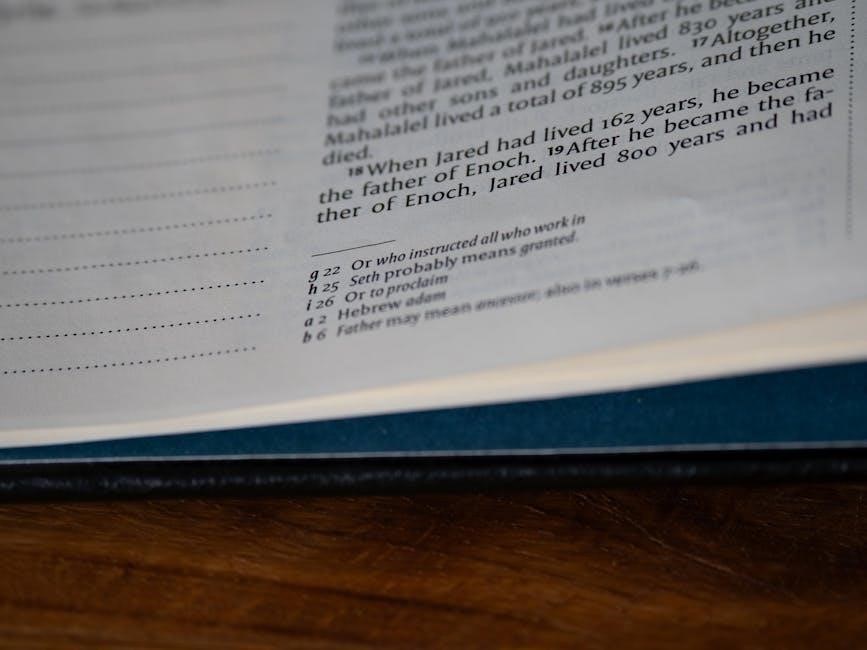
Even without integrated software, online Aramaic dictionaries can be used alongside PDFs. Resources related to texts like “Revelations of the Aramaic Jesus” (ISBN 9781642970418) may suggest specific lexicons. Prioritize lexicons aligned with the Peshitta dialect for accurate interpretations.
Understanding Aramaic Script and Language

Navigating Aramaic PDFs requires familiarity with the script, a variation of the Hebrew alphabet. While modern Peshitta editions often employ Eastern Syriac script, older manuscripts utilize other forms. Recognizing letter shapes and vowel pointing is fundamental.
Aramaic grammar differs significantly from English. It’s a Semitic language with verb-subject-object word order and a root-and-pattern morphology. Understanding these basics unlocks deeper textual meaning. Resources accompanying PDFs, like those for “Revelations of the Aramaic Jesus” (ISBN 9781642970418), may offer introductory language guides.
Consider learning the Aramaic alphabet and basic grammar rules before diving into complex texts. Online courses and introductory textbooks can be invaluable. Familiarity with related languages like Hebrew and Syriac can also aid comprehension. Don’t underestimate the importance of recognizing common Aramaic phrases and idioms.

The Aramaic New Testament in PDF Format
Accessing the Aramaic New Testament in PDF format opens a unique window into the original context of the Gospels and Pauline epistles. The Peshitta, the standard Aramaic Bible, includes a complete New Testament translation. Numerous digital versions are available, ranging from simple text scans to meticulously formatted editions.
PDFs often feature the Syriac script, requiring some familiarity with the alphabet; Interlinear versions, pairing Aramaic text with English translations, are particularly helpful for beginners. Resources like those associated with “Revelations of the Aramaic Jesus” (ISBN 9781642970418) may offer insights into the Aramaic New Testament’s nuances.
When selecting a PDF, consider the source’s reliability and the edition’s textual basis. Some PDFs are based on older manuscripts, while others utilize more recent critical editions. Exploring different versions can reveal textual variations and deepen your understanding of the Aramaic New Testament.
The Aramaic Old Testament in PDF Format
Finding a complete Aramaic Old Testament in PDF format presents a greater challenge than locating the New Testament. While fragments and Targums (Aramaic interpretations of the Hebrew Bible) are readily available digitally, a fully comprehensive PDF mirroring the Hebrew canon is less common.
Historically, portions of the Old Testament were translated into Aramaic over centuries, notably the Targums, which served as liturgical interpretations. These Targums, often found in PDF form, offer valuable insights into how the Old Testament was understood within Aramaic-speaking Jewish communities.
Resources related to the Peshitta, while primarily known for its New Testament, sometimes include Aramaic renderings of Old Testament books. Exploring digital libraries and specialized websites dedicated to Syriac texts may yield further PDF resources. Remember that accessing these texts often requires familiarity with Aramaic script and linguistic tools, potentially alongside resources like “Revelations of the Aramaic Jesus” (ISBN 9781642970418) for contextual understanding.
“Revelations of the Aramaic Jesus” and Related Texts
“Revelations of the Aramaic Jesus” (ISBN 9781642970418), published by Hampton Roads Publishing Company, Inc., represents a significant work exploring the historical Jesus through the lens of Aramaic language and culture. Available in PDF, epub, and Kindle formats, this 272-page book delves into hidden teachings and offers a unique perspective on Jesus’s life and message.
Related texts often focus on the Aramaic origins of the Gospels and the importance of understanding the nuances of the Aramaic language in interpreting the New Testament. These resources frequently appear as supplementary PDFs or are integrated into interlinear Bible studies.
Exploring these texts alongside traditional Aramaic Bible PDFs provides a richer understanding of the historical context and potential original meanings of Jesus’s teachings. They often emphasize the cultural and linguistic differences between Aramaic and Greek, highlighting how translation may have altered the original intent. Accessing these materials digitally enhances research and study capabilities.

Interlinear Aramaic-English PDFs
Interlinear Aramaic-English PDFs are invaluable tools for students and researchers seeking a deeper understanding of the Aramaic Bible. These PDFs present the Aramaic text alongside a literal English translation, often on a line-by-line basis, facilitating word-for-word comparison.
They are particularly useful for those without a strong grasp of Aramaic grammar, allowing them to trace the meaning of each Aramaic word and phrase. Many interlinear PDFs also include morphological information, detailing the grammatical function of each word.

Digital formats offer advantages like searchable text and the ability to copy and paste passages for further study. When combined with lexicons and dictionaries, interlinear PDFs become powerful resources for unlocking the original meaning of the Aramaic scriptures. They bridge the gap between the ancient language and modern understanding, aiding in accurate interpretation.
Benefits of Using Interlinear PDFs

Interlinear PDFs offer significant advantages for studying the Aramaic Bible. They democratize access to the original text, removing the barrier of language for those without formal Aramaic training. The side-by-side presentation of Aramaic and English fosters a deeper comprehension of the nuances often lost in traditional translations.
These PDFs facilitate independent study, allowing users to explore the text at their own pace and focus on specific passages. The ability to compare the Aramaic with the English translation enhances vocabulary acquisition and grammatical understanding.
Furthermore, digital formats enable easy searching, copying, and pasting of text, streamlining research and note-taking. Combined with digital lexicons, interlinear PDFs create a dynamic learning environment, promoting a more informed and accurate interpretation of the scriptures.
Challenges When Using Aramaic Bible PDFs
While Aramaic Bible PDFs offer incredible access, several challenges exist for the diligent student. Font rendering issues can sometimes obscure characters, impacting readability, particularly with the unique Aramaic script; The quality of PDF scans varies greatly; some may be unclear or contain errors introduced during digitization.
Navigating lengthy PDFs can be cumbersome without robust search functionality or a well-defined table of contents. Reliance on digital formats also necessitates a suitable device and software, potentially creating accessibility barriers.
Furthermore, understanding the Aramaic requires more than just a word-for-word translation; contextual knowledge and grammatical understanding are crucial. Simply possessing a PDF doesn’t guarantee accurate interpretation, and users should supplement their study with lexicons and commentaries to avoid misinterpretations.
Future Trends in Aramaic Bible Digital Resources
The future of Aramaic Bible PDFs and digital resources looks promising, driven by advancements in technology and growing scholarly interest. We can anticipate more sophisticated Optical Character Recognition (OCR) improving the accuracy of digitized texts, minimizing errors from older scans.
Interactive PDFs, incorporating embedded lexicons, grammatical tools, and multimedia resources, will become increasingly common, enhancing the learning experience. Expect greater integration with AI-powered translation tools, offering instant definitions and contextual insights.
Cloud-based platforms will facilitate collaborative study, allowing users to share annotations and discuss interpretations. Furthermore, the development of specialized Aramaic Bible apps, optimized for mobile devices, will provide convenient access to these resources. The trend towards open-source digital libraries will also broaden accessibility, fostering wider engagement with Aramaic scripture.